Happy Christmas to ya!!!
General mountain dulcimer or music discussions
Jumbo frets are taller than normal frets which effectively lowers the action
Generally w/ 4 string dulcimers the strings are thinner to lower the tension
I'll check it out.....thanks. I live in the east, and don't want to overcharge or Take a beating either. It's gotten so expensive!
Re shipping. Not exactly to answer the question posed. But a shipping suggestion.
I use a site called PirateShip. Free to join. They have discounted prices for UPS and USPS. Insurance and extra services are available if needed.
When listing a dulcimer for sale, and you get to the shipping costs part, can you simply put "actual shipping costs", and then let any interested buyer know exactly how much once they've provided their city and state? Thanks....
You're entirely welcome, friends! I'm glad to be able to contribute to a discussion now and then.
Thanks for all these neat details @john-c-knopf
Well, I wish I had paid closer attention to the details back in 1974 when I began my friendship with Lynn McSpadden. I didn't pay much attention to the kits or teardrop dulcimers at the time as I was enamored by the hourglass shape. I guess I built a half dozen or so of them before I started looking at building teardrops.
Ken
The dulcimer sings a sweet song."
(non-completed f-holes)
The reason I was so sure of the provenance of the dulcimer kit is that I used to study (and drool over) the brochures and catalogs that The Dulcimer Shoppe put out in the early 70s. And I remembered the shape of that model dulcimer (T8-W), and the non-completed f-holes, which drove me nuts! The builder had to complete the cutouts if they wanted proper f-holes.
I believe this dulcimer kit shares most of the parts of the M8-W kit that I bought as my FIRST dulcimer in 1974! That's right-- I've built all shapes and sizes of these critters for 50 years now.
I am unable to take any more photos, it was someone in the audience we were playing Christmas music for - who had it and I was speaking with him about it.
(Dulcimer Factory instrument ) they usually have a fatter sound box and a wider fret board but yes, a similar head.
It maybe too much of a mystery without me having it to further check & or photo
thanks guys
Okay, time to eat my words and apologize to John for doubting him. I went back and looked at McSpadden catalogs for the late 1970s and early 1980s and found that McSpadden produced a T-K4 kit based on there T-9W dulcimer. The catalog photo, which isn't very good, strongly resembles your dulcimer Marg. It should be approximately 35 1/2" long, 5 7/8" wide, and 2 1/2" deep. It describes the peg head as having "a single leprechaun shoe curl.
John, I think you nailed it. Again my apology for ever doubting you. You the man!
Ken
"The dulcimer sings a sweet song."
Your picture of the "bridge" end doesn't show enough to make good guesses about it. Two photos, top and side, could help.
A straight on side shot of the head might also help. There are, I think, quite a number of variations of that "leprechaun" shape when all builders are considered. We might match the profile.
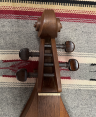
The tuner set-up interests me. The wholes are drilled straight through as though violin pegs were to be used, but the tuners installed are banjo or ukulele type.
Marg, there really isn't a nut as the zero fret serves that purpose. It is a string guide to keep the strings in the right places. I think Wally may be on to something. The peg head looks similar to one I had on a Dulcimer Factory instrument (which I no longer have). On to further searching.
Ken
"The dulcimer sings a sweet song."
Thank you, @marg !
Wishing you & all a lovely holiday season!
ken
( sound holes appear to un-McSpadden ) and the wood.
What about the nut & bridge, can the way, they are made - ring any bells
thanks, everyone for the possibilities
Hill Country Dulcimers, successor to The Dulcimer Factory (TDF), used a variation of that style head and a zero fret in 2002. Possibly TDF also made a model in this style. I think both produced kits.
See the following for an example.
I'm not as sure as John is about the provenance of this dulcimer. The only thing that speaks McSpadden to me is the zero fret. I'll need to look through my McSpadden material to check. I don't know that much about the years from1962 - 1974, so I'll see what is in the files. The material used in making this instrument and sound holes appear to un-McSpadden like to me.
Ken
"The dulcimer sings a sweet song."
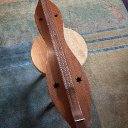
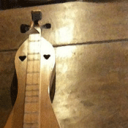
Marg, that is, for sure, an early teardrop kit from McSpadden, which was known as The Dulcimer Shoppe back then. The shape of the scroll was called a leprechaun curl, and the other kits had them also until they switched to guitar-type pegheads.
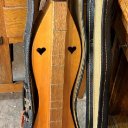
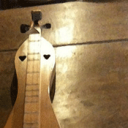
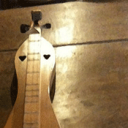
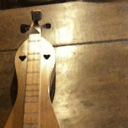
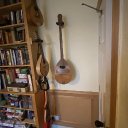
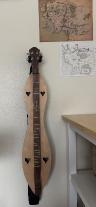
The group I play with was preforming today and someone from the audience had - what looks like - it was make from a kit. Who ever made it did a very good job but there is no label or any markings that would give me a hint on maybe the kit used.
I only have these few photos, the sound hold is very different, maybe a clue. It does have the 6.5 but the older screw tuners & small nails for the string pegs. Also no violin lip/ smooth straight sides.
Any guesses would be great
thanks
Very nice collection, Peter. At least while the McSpadden's owned the company no dulcimer was made by an individual. According to Lynn McSpadden the person who was responsible for gluing on the backs on a particular day was the one who signed the dulcimer. By that time someone made the fretboard, another worked on bending the sides, another gluing the sides to peg head and tail piece, etc. The last glue up was adding the back to the already completed top, sides, fret board, tail piece, and peg head glue up. After that someone else did the final sanding. Then there was the next step of applying the lacquer finish by someone else. There were at least four or five people who signed dulcimers initially. I think Richard Stolze and Larry McSpadden continued to work for the Dulcimer Shoppe after it was sold, so they continued to sign instruments. If people want to believe that one person made their dulcimer, they can do so, but that simply wasn't the case with McSpadden dulcimers.
Ken
"The dulcimer sings a sweet song."
Nice collection Stoltze McSpaddens. It's such a blessing that you have dulcimers and a heart to lend them. We have a number of great dulcimer folks on the forum who have loaners. Its the best way to share our love of the dulcimer with others to allow them to become addicted like we are. Thanks for sharing.
Wally, thanks for the info, especially about having the bridge inside edge the highest. I wondered about that since the breakover point in the bridge would be hard to determine with a flat slot!
All of these four McSpadden Dulcimers have one thing in common: they all were made by Richard Stoltze.
When I bought my first Mountain Dulcimer from The Dulcimer Shoppe in October 2012, it was the first time I heard of Richard Stoltze. He was the maker of my beautiful 4FHWW with ebony fretboard (the one on the very right). Still today I am happy about the perfect craftsmanship, the beautiful black walnut wood and most of all of the warm and clear sound.
I know that many hands work on a McSpadden dulcimer. Anyway, there's always one responsible maker who puts the instrument together. The surname "Stoltze" is probably related to the German word "Stolz" which means "pride". You can be very proud of all the great instruments you made during your working life. They still make thousands of people happy. Thank you, Richard Stoltze 🤗
Recently I bought three pre-used McSpadden dulcimers. All of them are in very good condition. I want to be able to lend a good instrument to interested people. From left to right you can see:
FM12-W No. 17745, no date given
T34-W No. 29808 July 1994
SH12WW No. 48864 June 2005
4FHWW/e No. 57739 October 2012
You don't need to buy a replacement blank made of bone, or other super-hard material. Those can be a good choice, but they are hard to shape.
You can use hard wood. that is easier to shape with sandpaper. You can start with a longer piece to make it easier to hold.
It is important to properly slope the slots, not just space them correctly. The inside edges need to be higher. The slope may not be readily visible on the original.
The slope or curvature of the top isn't musically important.
By the way, I don't think the question of a "zero fret" has been raised. If you have one, the "nut" is just a spacer, and all this discussion is irrelevant at the head end.
It finally dawned on me that the octave fret (7th fret) has to be dead center as to the VSL or nothing will be right! So, as you indicated, no change to the VSL or it will be a mess! Thank you all!
Also, if you were to get a nut of a different thickness, which I don't recommend until you understand the instrument better, the most important thing is that the length of the VSL isnt changed. Under no circumstances should a new nut and bridge cause the VSL to become any longer or shorter. A new nut and bridge should snugly fit against the inside edges of the slots from the old nut and bridge.
Is there an optimum spacing for the two melody strings, or at least a minimum spacing that would avoid the strings vibrating and touching each other? In general, can existing slots in the bridge and nut be filled in with super glue, wood putty, or something, such that new slots can be cut using different spacing? There may be a partial overlap of the new slot to the old. The strings will be .010's. My bridge and nut are glued in so replacing them would not be fun! Thanks!
Thanks for the info and Merry Christmas!
I've used Franklin Titebond wood glue for years and am happy with it, I can heat a bad joint and pop it open quite easily if needed. And it's quite strong for my purposes.
I have a video from McSpadden produced in the mid 1970s where Lynn McSpadden says that used aliphatic resin glue in building his dulcimers. This is what I used when I made my first few dulcimers around that time. It came in a can as a powder which you mixed with a prescribed amount of water. Of course, you could make it as thin or thick as you liked, but the thicker you made it caused the glue to crystalize creating weak joints.
Lynn began making a dulcimer in 1962 and finished it in 1963. I don't remember him ever telling me that he used hide glue.
White Elmer's glue has a polyvinyl acetate base. The yellow wood glues contains less water and is aliphatic resin based.
Ken
"The dulcimer sings a sweet song."
Ken Longfield said "Back in 1974 I would guess that McSpadden recommended using a wood glue like Original Titebond or Elmer's Wood Glue."
I would agree as far as kit instructions go.
The "factory team," including kit assemblers, might well have been using hot hide glue mixed from powder.
see: http://www.makingtheviolin.com/Glues
Most other wood glues for serious work only became available after about 1950, and the traditional stuff still has a following, partly because it can be disassembled with modest heat.
Back in 1974 I would guess that McSpadden recommended using a wood glue like Original Titebond or Elmer's Wood Glue. As John says, they'd only have a drop or two of glue coming from the factory, but if this is a home assembled kit, it is difficult to know what glue was used. I could be white Elmer's glue which makes it very easy to disassemble. You might check at Stew-Mac to see what nut blanks they have available. I'm sure you can find something that will fit your dulcimer. You want to the surface of the nut butting up against the fret side of the slot. If it were to butt up against the peg head side you would be changing the VSL and throwing the intonation of the strings out of whack.
John's suggestion of check at a Guitar Center or local music shop for a nut blank is also a good idea. You won't pay shipping that way.
Ken
"The dulcimer sings a sweet song."
I'd guess the McSpaddens used wood glue for assembly. I don't think super glue was "a thing" way back then.
If the nut and bridge were glued in the traditional way, they'd only have a drop or two of glue holding them into their slots, making them easier to remove with a sideways tap of a hammer as mentioned below.
You don't want to use a nut blank of different thickness than that of the original one. You'd be asking for trouble. See if a guitar shop like Guitar Center sells something you could use. And mask-up if you cut bone, as it's nasty stuff to breathe!
Thanks for these ideas! After Christmas I will probably try replacing the bridge and nut. Did the 1974 McSpadden kits use wood glue or super glue? Will the "rap" work with either, or just the super glue? My current nut and bridge are both just under 5mm wide. I noticed the Delrin replacements are 1/8 inch (3.175mm). Would centering in the slot provide the correct breakover or should I move the Delrin up against the slot wall toward the fretboard? The difference might not be noticeable as long as I stay perpendicular to the strings. Thanks again!
I agree with John on the 1/8" spacing. Any closer and you are sure to have problems. Depending upon the glue used your should be able to remove the bridge with either water/heat for wood glue or a sharp side ways rap with a hammer for super glue. In the first method I use a little water placed along the bridge where it meet the slot it is in and then use a heat gun to soften the glue. As the glue softens I can pry the bridge out of the slot. In the second method I use a piece of wood the width of the nut, place it against one side of the nut, then hit the wood sharply with a hammer. It doesn't have to be hard hit. Make sure you have the dulcimer securely clamped in place so it doesn't move when you hit the bridge. On hourglass dulcimers I place the dulcimer on its side and can put my right arm in its waist while holding the stick on the bridge. Then I can give it rap with a hammer. Be careful.
I have used very fine wood particles which I save from sanding. I have small bottles of ebony, rosewood, walnut, maple, and oak dust which I use on corresponding bridges. The finer the wood dust, the better. Even though it will harden quickly, I let it set for an hour or so before trying to add new slots.
Ken
"The dulcimer sings a sweet song."